
Get to Know Your Grasslands: Sprague’s Pipit

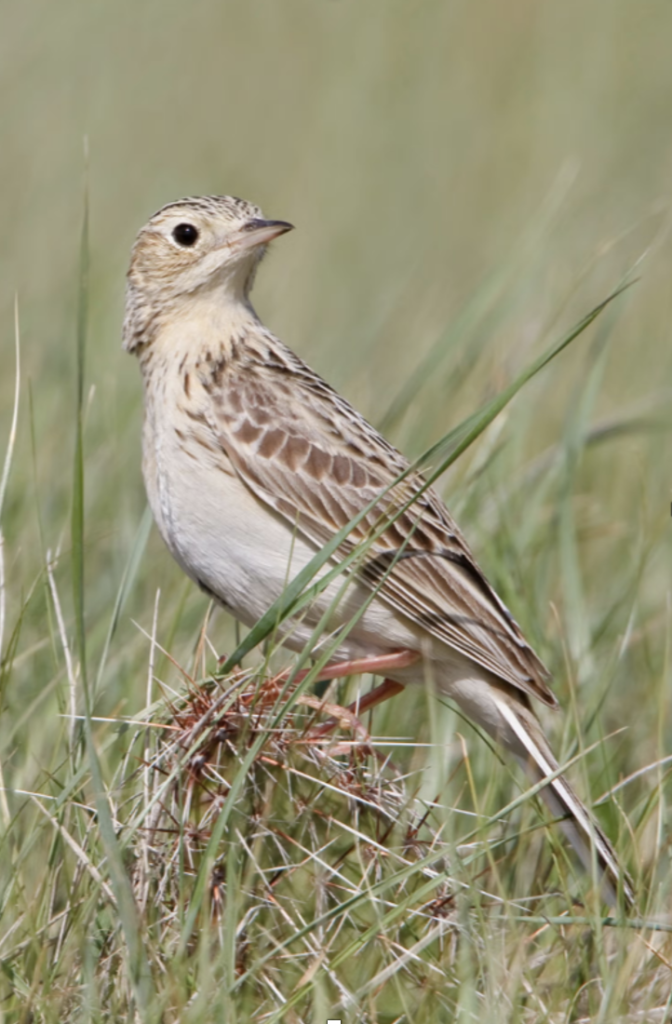 The small passerine songbird bird known as a Sprague’s Pipit (Anthus spragueii), could often be described as an embodiment of the grasslands themselves. While the prairies to someone passing through might not prove as dramatic as a mountain range, spending time in a native grassland can rank amongst the most majestic landscapes one can experience. Likewise, the cryptic Sprague’s Pipit may be easy to overlook, but it more than makes up for its subtle appearance with an extraordinary song and aerial mating display, experienced by those who are willing to slow down, look up, and listen.
Sprague’s Pipits over-winter in the south central United States and northern Mexico. Upon their return to the Canadian prairies in late April, the males vie for extensive territory ranging from 2 to 11 acres. They rely heavily on large tracts of native grassland for suitable habitat, with males requiring surprisingly large territories despite their small size. Sprague’s Pipits are commonly found in areas with at least 160 acres of intact grassland. Sometimes referred to as the “Goldilocks bird” of Saskatchewan’s native grasslands, they prefer vegetation that is not too tall or too short, with some litter, just right for nesting and foraging.
Their typical nesting grounds are characterized by native grasslands of intermediate height (10-30 cm), moderate litter accumulation, and low shrub density. In some regions, Sprague’s Pipits will breed in tame forages where the vegetation structure resembles that of native vegetation. However, nests have also been found in seeded hayfields.
Females build their nests on the ground out of fine grasses that are woven into a cup shape. Longer grasses are shaped to form a dome as camouflage and protection from the elements. Females lay 3-6 eggs per nest and can have 2 clutches per breeding season.
Known as one of the more secretive and elusive grassland specialists, Male Sprague’s Pipits engage in a remarkable courtship ritual to attract their mates. Rising 300 feet or more in the air, a male will circle his territory while singing a range of descending, tinkling notes. After finding an approving female, the male will continue this display, spending up to 3 hours a day in undulating flight. Rarely are they seen out in the open on the ground, most often they are identified by their distinct songs being sung overhead.
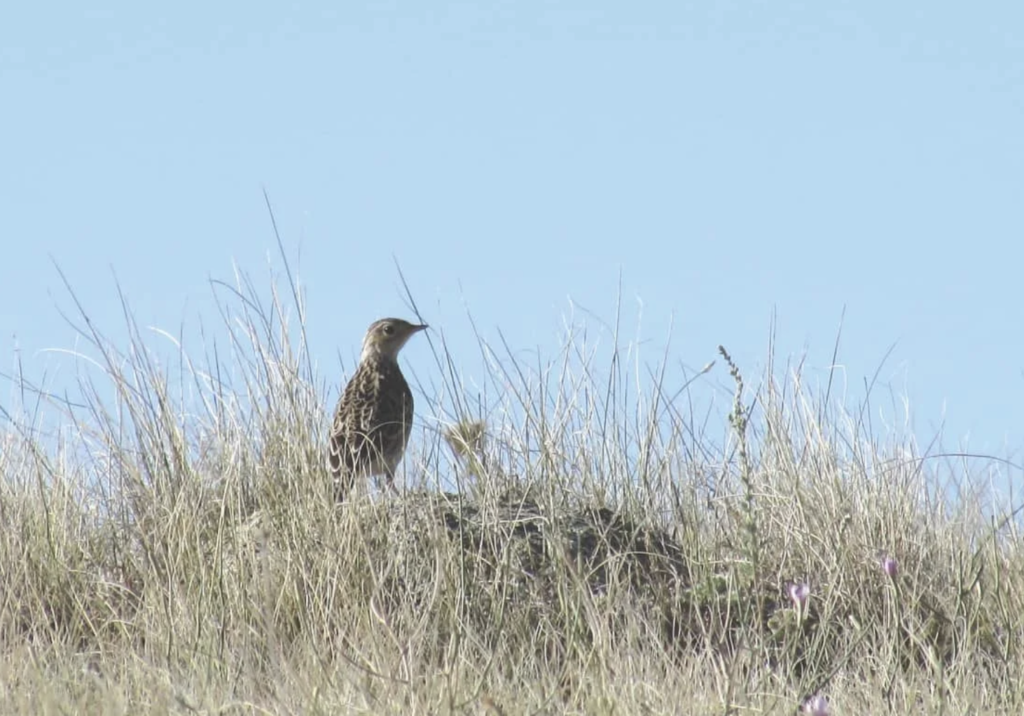 Unfortunately, these unique prairie birds are designated as ‘Threatened’ under COSEWIC – one tier below endangered and defined as, “A wildlife species likely to become endangered if limiting factors are not reversed.” Grassland bird decline is largely attributed to the large-scale cultivation of native prairie over the last century. Extensive habitat loss and fragmentation is occurring on both the critical breeding and wintering grounds of Sprague’s Pipits. Well-managed pastures of native grassland provide a stronghold of habitat for Sprague’s Pipits and many other species endemic to the Canadian prairies.
Sprague’s Pipits can serve as an indicator of healthy native grasslands because they rely on open prairie with the right mix of vegetation height, density and ground cover. For ranchers, their presence can be a sign that grazing management is helping maintain the diverse grassland structure that benefits both livestock and wildlife. Monitoring Sprague’s Pipits alongside other grassland birds can provide valuable insight into pasture health and how management practices are shaping habitat over time.
The next time you’re out on the range, keep an eye, and ear, out for the Sprague’s Pipit, a small but remarkable reminder of the wildlife that calls Saskatchewan’s working grasslands home.
Author: Megan Wall