
Get to Know Your Grasslands: Cacti

What is the first thing that comes to your mind if someone says the word, cactus? Do you picture the towering Saguaros in the Sonoran Desert or does the scene from an old western movie come to mind? It can be surprising to most people that here in Saskatchewan, you are able to find three different native species of cacti!
Saskatchewan is home to three native cactus species, all in the Cactaceae family. They thrive in warm, dry, well-drained areas and are remarkably drought tolerant. Their main adaptation for surviving dry conditions is reducing or eliminating leaves and storing water in thick, waxy stems. These stems not only conserve moisture but also carry out photosynthesis, allowing the plants to survive with minimal water.
The three types of cacti that call here home are the Pincushion cacti, Brittle prickly pear and Plains prickly pear. All three of the cacti species are perennials with shallow, widespread and fibrous root systems. In late spring and early summer, these plants produce flowers for a brief but picture worthy window. While flower colour and form vary by species, they all share similar traits: blooms are radial, solitary, and highly showy, standing out against the surrounding grassland. Due to their spines, cacti are not commonly grazed by livestock although it is not impossible.
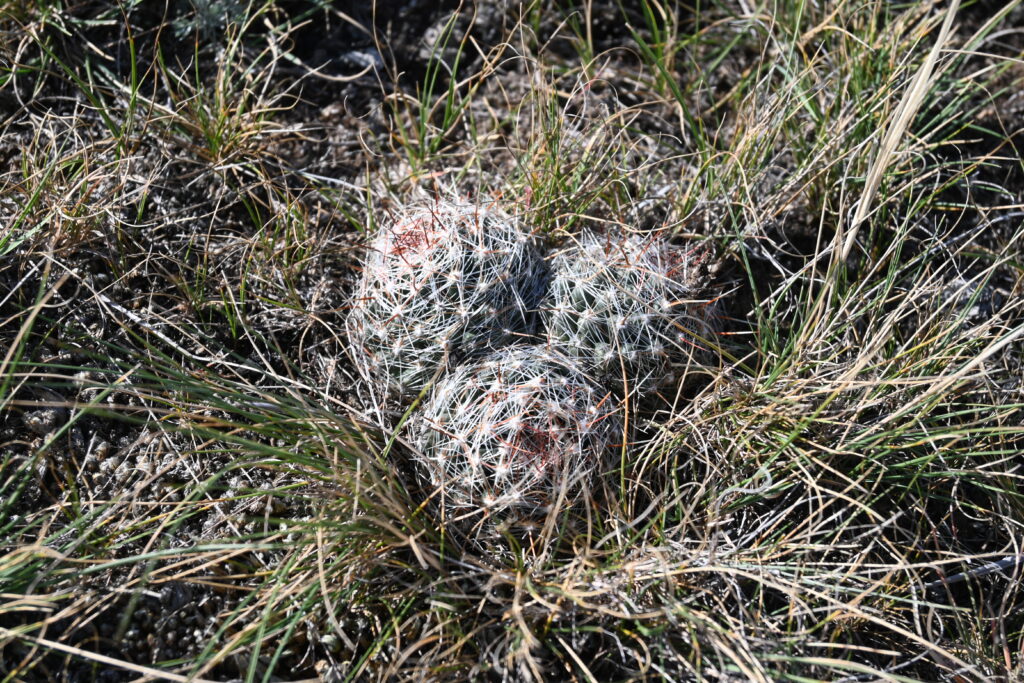
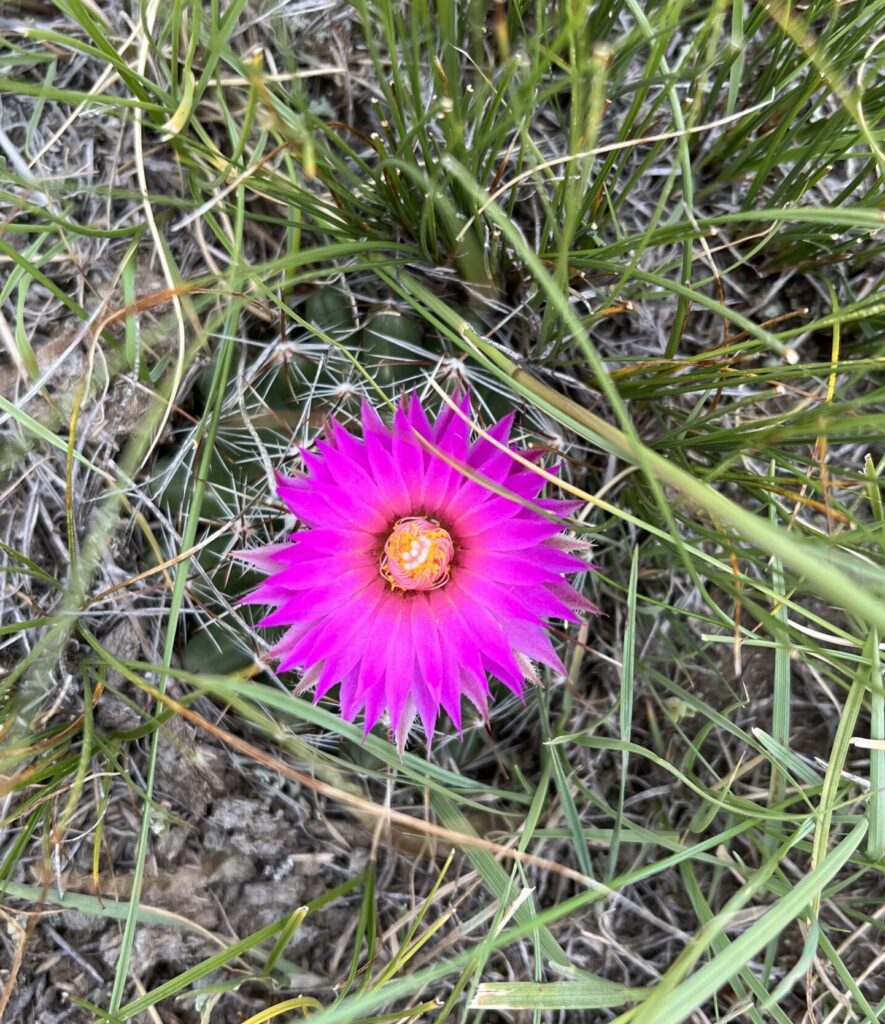
Pincushion cacti (Mamillaria vivipara) can be easy to recognize once you know what to look for and as the name suggests, they look similar to a small pincushion, small, round and covered in short spines! Either growing alone or in small clusters of up to ten plants, they can reach a height of about five centimeters and a diameter of up to 7 centimeters each. Each cacti is covered in cone shaped bumps and tipped with three to six spines and fine white hairs. In the late spring to early summer, pincushion cactus really shine when they bloom with vibrant flowers that are bright pink with a yellow center and can almost cover the plant.
The two kinds of prickly-pear cacti are very similar to each other can be a little difficult to distinguish the difference between them. The less common Brittle prickly-pear (Opuntia fragilis) is low-growing and spreads out across warm, sandy, exposed hillsides. Its thick, jointed pads break off easily, hence the name “brittle.” These detached segments can stick to wildlife or livestock, eventually rooting in new locations, making it excellent at spreading across rangelands.
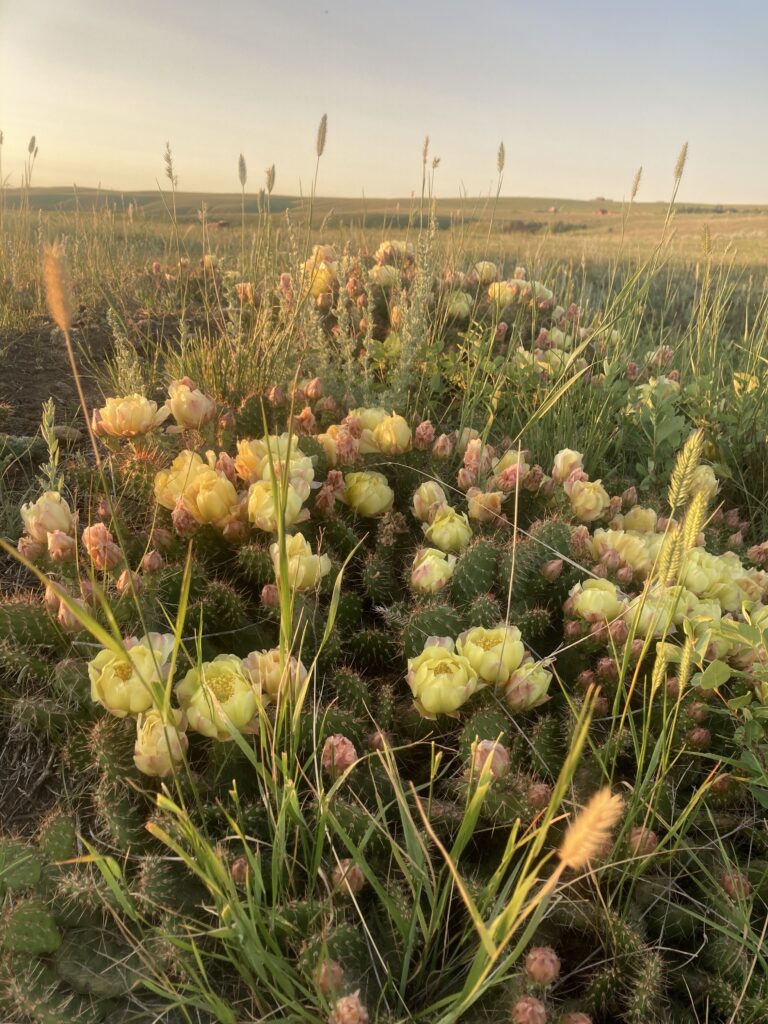 When flowering in May to June, flowers emerge from segment margins and are yellow with nearly ovate petals, and will turn pink or orange in the flowers center with age. The stem segments are thicker and more rounded than plains prickly-pear. In May and June, it produces yellow flowers that often turn pink or orange toward the center as they age. The spines are short but stiff, with the younger spines being barbed. Aside from the pain that the spines can cause, their small white hairs and fine bristles around the spines can also cause skin irritation.
The Plains prickly-pear (Opuntia polyacantha), like the brittle prickly pear, also stays low to the ground and spreads by breaking off jointed stem pads. The difference is that Plains prickly pear has noticeably larger pads that are flatter and thinner. These pads are usually a brighter green, almost a blue-green, making them stand out more on the landscape.
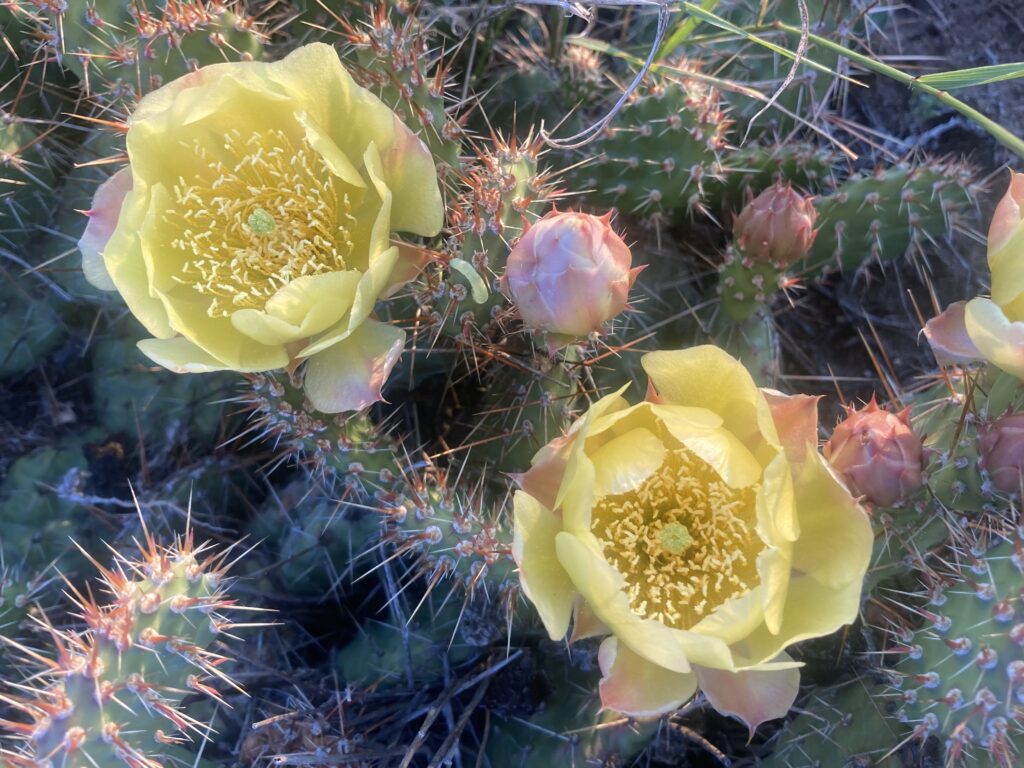 Plains prickly-pear is also easier to spot from a distance because it has bigger spines and larger, showier flowers. The spines are longer and stiffer, and the plant also has fine, barbed hair-like spines that can be irritating to people and animals. In late spring to early summer, it produces bright yellow flowers along the edges of the pads. As the flowers mature, the centres often turn pink to reddish-orange. This cactus is most commonly found on warm, dry, sandy to gravelly hillsides and hilltops where soils drain quickly and grass cover is thinner.
Saskatchewan’s cacti may be small, but they’re tough. These hardy perennials thrive where few other plants can. Built to store water, endure drought, and shrug off most grazing, they can add unexpected color and character to our rangelands and hillsides each spring and summer. Cacti in Saskatchewan are proof that even in harsh conditions, life finds a way to stand out.
Author: Shoni King and Mindy Hockley-Anderson